Monday, May 22, 2006

Riot by Shashi Tharoor

Genre: Politics/Religion
Story line: Begins with an American student killed in a communal riot in India, and deals in detail with the riot’s background and the student’s personal life.
Sum up: Religious extremisms and marital infidelities rule
Target readers: Secularists
Number of pages: 269

I could not help getting reminded of Bram Stoker’s Dracula continually while reading this book. Not that there is anything supernatural about Riot, but the whole format, and to some extent, even the writing style flashed me back to the most celebrated horror epic ever. But the author’s attempt in the words of one of his characters, V. Lakshman is probably to deliver an “encyclopedia”: You pick up chapter 23, and you get one thread of the plot. Then you go forwards to chapter 37, or backwards to chapter 16, and you get another thread. And they’re all interconnected, but you see the interconnections differently depending on the order in which you read them. It’s like each bit of reading adds to the sum total of the reader’s knowledge, just like an encyclopedia.

The plot runs back and forth in time, and is a mix-up of excerpts mainly from the characters’ personal diaries. What I found baffling was that among the cleverly arranged newspaper clippings, diary scribbling, scrapbook pieces, notebook accounts, letter exchanges, journal sections and recorded tapes, the author has placed some blunt and obscure addendums like Lakshman to Priscilla and Prof. Sarwar to Lakshman. Now, what the X to Y actually stands for is a big misnomer for the readers who begin to doubt their standing as third-person observers. Are these the author’s own narrations? Or overheard conversations, maybe? Confounding…

A stickler to Wilde’s philosophy of “form being more important that content”, Tharoor takes care and makes sure that he changes the font, size and formatting of the text every time. This would not have been an essentiality, as the characters are required to speak for themselves; moreover, it proves to be a versatile distraction. Also, I did not get the implications in changing the v’s to w’s and w’s to v’s in the transcript of the interview of Shankar Das. If the idea was to convey that the man’s English was thickly Indian-accented, it was a very sore point. But for all these weaknesses, the format helped put across the plot so forcibly that in the beginning few pages, I could actually hear [a step ahead of visualizing] sirens blaring, babies crying, fires glaring and shop closing, curfewed after[riot]math itself. Half my review has been about the “form” rather than the “content”, owing to the author’s own prioritization.

Spoiler begins. Those reading this must mostly be the ones who turn to the last page of murder mystery novels. So, here goes your excitement down the drain: there is no suspense which is going to unwind and spring surprises on your face; there is no particular cold-blood-murderer zeroed at and punished for his brutal act, and the end of the book is as inconclusive as the start. This, according to me is the best thing about the novel, and I know many of you might disagree with me. In fact, jumping back to commenting about the formatting technique, I like the way in which the novel ends with a [continued] newspaper clipping, producing the required dramatic effect in abundance. Spolier ends.

The best read of all personal diaries to me was Katherine Hart’s. Be it describing how she felt sitting next to her ex-husband on flight, wondering how “her baby” had coped in an Indian-style squatting toilet, or defending when her dead daughter’s Indian interests are insulted by her co-worker Kadambari :- the character shines and so does the writing in these parts. But why she does not pursue investigations even after her assertion about the daughter's love/lust life is a mystery. Rudyard Hart, fresh from mourning his daughter’s death, talks more about his passionate infidelities and less about his dear child’s mysterious departure, in a drunken state. Though it helps in keeping the story moving, it fails to glorify the actual motive in his trip across the globe.

Lakshman’s explanation of why and how he believes in Hinduism is a good read. Religious [for that matter, any] fundamentalists are usually expert speakers, convincing the listener of what they call “the truth”. The author holds a strong fort here, and the non-exaggerated ramblings of the Hindu extremist Ram Charan Gupta, hits the bull’s eye. Randy Diggs, introduced as the impatient but witty reporter, could have been afforded a more elaborate character sketch, and his perspective [apart from the interviews] would have provided an interesting insight since he is the one who meets all the characters that are living.

The novel definitely has some intelligent remarks scattered throughout, many with an undeniable undertone of sarcasm:
The Indian government has apparently become rather good at managing these riots, and people like Mr. Lakshmanan [District Magistrates] are trained at riot control the way a student is trained to footnote a dissertation.
…Mrs. Gandhi ended her state of emergency and called an election… She had been a dictator, for all practical purposes, for twenty-two months she’d ruled under emergency decrees, and here she was, allowing the victims of her dictatorship the right to decide whether she could continue her tyranny.
Everything is recycled in India, even dreams.

Friday, May 19, 2006

East, West by Salman Rushdie

Genre: Short stories
Sum up: Stories set in the title-implied geographic locations
Target readers: Literature students and language critics
Number of pages: 211

East, West is an anthology of short stories, comprising of three sections: East, West and East, West. Who better than Rushdie to talk about the two latitudinal extremities of the globe, and mystifying amalgamation of both? However, I would advise that each story be dealt with separately and not as a book as such, for then the residual taste of uniqueness in language for each story might be lost. This man is a warehouse of imagination; he uses random words in incongruent places, yet they don’t seem to be out of place. More than any of his stories or plots, what amazes me is the way in which English gloriously suffers in his hands, while he whips and whacks his way through the readers.

East consists of three stories. If the author’s name is kept a secret to anyone who reads Good advice is rarer than rubies, he would plainly mistrust you when you disclose the name. This story which has already appeared in the New Yorker is a complete let-down. The free radio has a cynical touch throughout, a tried-and-tested field for the novelist, and he carries it off in precisely his trademark way making it my best in the East. The prophet’s hair is a thriller-ride with a lot of carnage, too wild and ghastly for my liking, but it is sure to titillate blood in most young veins and gain vigorous nods of approval. The "thief of thieves" provides his children a life-long source of high income by crippling them at birth… amusing, but I shuddered.

The three stories in West bear a pure Rushdian-stamp at heart. Yorrick is my personal favorite in the book, though I could not make any sense out of the first page of the story. In the first person narration of Hamlet’s jester Yorrick, the author deliberately wanders away garrulously with the reader trailing behind hoping against hopes that he would find a full stop somewhere to take a breath. At the auction of the ruby slippers, makes a complete mockery of the whole process, royally butchering the egos of the auctioneers who go running from one sale to another, of items ranging from false teeth to used lingerie. I felt Christopher Columbus and Queen Isabella of Spain consummate their relationship, which has also been published earlier in New Yorker, is fabulous in neither plot nor prose, and is worth a skip.

All the three stories in East, West are out in print for the first time, and are brilliant. The harmony of the spheres, appropriately named in the first place, narrates the tale of two friends and their flames. It has a very O.Henrical ending, though in a darker fashion. Chekov and Zulu are fancy Star Trek inspired code names for Indian Diplomats in England. What they face as a consequence of the assassination of Indira Gandhi, culminating in the bomb blast of Rajiv Gandhi's, is an ingenious portrayal of one of the least-exposed professions. It might not be an easy read for non-Indians, given the implicit implications of the two deaths and the conversation with the thickly accented Mrs. Zulu, and could prove to be a yawn. The courter is probably the sweetest Rushdie can get with his stories, and notwithstanding, his sweeter side is sweet enough. The love story between the sixty-year old ayah Certainly-Mary and her porter-cum-courter Mixed-up, as seen through the eyes of a teenaged rich-kid, is truly touching. This story holds the honour of being the lengthiest, earthliest and gentlest of all.
Related blahs: Just picked up...

Thursday, May 18, 2006

A Suitable Boy by Vikram Seth


Genre: Romance/Politics
Story line: More about unsettled newly-independent India and its outcomes at various levels, and less about a desperate mother finding a match for her daughter
Sum up: An intelligent mix of ups with downs
Target readers: Contemporary
Number of pages: 1349

But I too hate long books: the better, the worse. If they’re bad, they merely make me pant with the effort of holding them up for a few minutes. But if they’re good, I turn into a social moron for days, refusing to go out of my room, scowling and growling at interruptions, ignoring weddings and funerals, and making enemies out of friends… How true are these words uttered by the poet-cum-novelist Amit Chatterji, one of the prospective suitable boys in the novel and also a character strikingly resembling Vikram Seth himself… The 1349, no, one-thousand-three-hundred-and-forty-nine-page book had always put me off; occupying my book shelf unread but not untouched, for quite a long time. But once it was begun to be read, there was no question of putting it down.

Half of the poem, A word of thanks, in the first page makes sense only when read in the end, so a word of advice would be not to get stuck there. The way the contents page has been written in verses is quite charming, and I had to exercise a lot of refraining in order not to look it up before the beginning of a new chapter. After the first four chapters, I had comfortably settled for a modern Indian Jane Austen tale, when the fifth chapter jolted me out of my trance; whether I was displeased to suddenly be required to sit up and concentrate in the then political affairs or was pleased that it was after all not a happy-family sad-family topsy-turvy love saga, I am not sure. Though some of the main characters like Mrs. Rupa Mehra, Savita and Lata did remind me of Mrs. Bennet, Jane and Lizzy, the comparison might end there. While Austen is all worldly words and pretty prose, Seth is more simple and straightforward both in style and story.

It was initially very distracting and almost distressing to see the mention of an imaginary Brahmapur, which is the capital of yet another imaginary Purva Pradesh, among the likes of Calcutta, Kanpur and Lucknow, but somewhere down the road, the feeling dissolves. Similarly, it was hard to consider Nehru as one of the story’s characters, and though amusing that he should write to the Chief Minister of a non-existent Purva Pradesh, the clever usage of letters written by the ex-Prime Minister himself provides credibility. The criticism at the political level and [mal]operation at the rural level as a consequence of the proposal of the Zamindari Abolition Act, as described by Seth, are cynical and troubling respectively. The unwarranted communal riots, the boundless Hindu-Muslim tension, the liberated friendship among people of contradictory beliefs and the abiding courtship between the youngsters of other faiths: all coexist symbiotically in the story.

It was unnecessary for a flowchart of characters; they have been sketched so vividly that one hardly needs to refer to it. Maan Kapoor, whose life the novel follows for most part, fails to gain any attempted sympathy towards the end, when he lands himself in serious trouble, half so because his flirtation and obsession with his beloved gets annoyingly repetitive. Though a dogmatic reader and a strong opposer of any kind of blasphemy to books, I had to turn over several leaves as he goes through the same routine of getting physical after drenching himself in whisky or being thrown out indignantly, on his every alternate visit to her. The stint at the village of Debaria where he accompanies his friend-cum-teacher Abdur Rasheed, provides a fresh lease to the story; more so, because these villagers are not connected to everybody else, like the other characters in the book are. However, it is interesting to see the way in which most of the characters are related to one another in a flawlessly smooth fashion.

The Chatterjis are a delight. But for the elder sibling Meenakshi, who though is officially a Mehra by marriage from the start to the end, the rest of the Ballygunge gang, who “just exchange brilliances”, inclusive of Cuddles the dog and the one called Biswas Babu, constitute of an amusement park; and the ever-blinking, “ideal”-searching, indecisively-decisive, spiritual [crisis] guru Dipankar stands above all. Though some of Kakoli Chatterji’s couplets are both funny and intelligent, it is somehow baffling that most of the members in the story starting from a Minister’s son to a High court judge can recite poems with incredible ease. The letter exchange between Lady Baby’s parents, immediately after her birth, also form an amusing read. Lata Mehra, whose is the one to be hooked up with A Suitable Boy, provides a justification in instinctively choosing the “one” among her suitors, which sounds as unappealing as how one of my friends strongly believes that she will not be happy with a non-software professional; but given girls have peculiar prerequisites and checklists, there would probably be some reader empathizing with her choice.

Set in the initial years of India’s independence, I was wondering which middle class family even from as urbane a city as “Brahmapur” would converse in English among themselves, have at least a cook and two servants, serve alcohol and play cards at home. Probably, India once really was more broad-minded? If you are in mood for nothing in particular, the book would be an excellent choice. Though I would go back and re-read many of the chapters, I would not vouch that A Suitable Boy is the best-ever [as many people do] I have read.

Saturday, May 06, 2006

Time off…

In a whimsical outburst of emotions, my parents have decided to get the walls and ceilings of the house beaten black and blue with shades of green and red respectively. As a further aggressive unwarranted act, I am being thrown out of not only the house but the town for a few days, since they want some peace while the work is getting done. So I would not be blogging at least till next Wednesday. This might be of quite a relief to Bhavana who has been complaining that I write too much too fast!
This post has nothing to do with the dude featured in the picture. Since my blog had had the highest number of hits when Jolie was on the cover, I am just curious to see whether it has something to do with who sells what rather than what is being sold… For those grinding teeth, here is a bit of mirchi news: Suri’s favourite book is The Alchemist, now how exciting can that be!!! [used this as a pointer]

Books? Prints? May be you are talking about block-printed saris…

I have never bought a book from Barnes and Noble. And, I am very proud of this particular fact. There was this small corner bookshop called Food for thoughts near my apartment which I used to pledge by. Very occasionally whenever I forgot to pack some reading material in my luggage, I would desperately buy something from Hudson news, with extreme guilt, all the time thinking how happy Jess would have been if I had bought it at her petty shop. For me, You’ve got mail was more than a chick-flick with Meg Ryan waiting to be kissed by Tom Hanks in the last scene; it is about a young woman struggling to make her small yet intimate bookshop survive against all odds.

In India, even if you come across such small Sri Ganesh Book traders, they carry only Java for the dumbest dummies or Speak English in 2 hours and 24 minutes, or worse still, some thriller with a semi-naked woman on the cover. Chennai is probably not the worst of the cities when it comes to book availability scenarios. Landmark and Odyssey cater to a great extent the needs of the city’s booklovers, though Higginbotham’s will always remain my best. Javed Akthar feels booksellers are busy selling saris, and that’s why there is a consistent lack in books out there. God help!

Friday, May 05, 2006

Me too...

Since the book-concerned media is completely busy churning up more news on the already well-established embarrassment of the young plagiary-artist, I thought I would join the gang, and participate in the anti-Kaavya parade. While in one corner, the Rushdiean voice has been crooning that the author is a victim of her own ambition, in another dimension of the world, her “limited edition” second-hands are being sold at four hundred and ninety five freaking US dollars. People say this, and people say that, I would say this-and-that, since it is a proven fact that double-standards have their own ways of right in this country. As though the permanent book withdrawal and nullification of the contract weren’t enough to spoil the girl’s not-yet-begun career, Harvard is now actively considering taking disciplinary action. Probably the US government should also consider canceling her citizenship, and sending her to Mars. If she still fails to do something original, and jumps back to earth copying the previous person who had landed on Mars, she could be tried again, this time with fresh charges. Humph, feeling better...

Related blahs: A Cinderella story with an anti-climax, A series of [un]fortunate events, [insignificant] Background...

[insignificant] Background...

Rewinding a little bit into the past, my best friend’s cell phone rang when she was in the middle of an office meeting. Caring least about her or her stupid work, I declared philosophically that I was feeling very bitter, about life as such. Eager to dispose me off, she suggested that I vent it out on somebody. She was also quick enough to sense her own victimization over her brilliant idea and hung up on me. Left with no other choice, I picked up a Vikram Seth to get it out of my system. The author, being smarter than all his readers put together, was in turn taking all his wrath out on me. Just then the omniscient world wide web laughed at my innocence, and pointed out that the whole literary world was making the most out of Kaavya’s helplessness, and so I am just following suit…

Wednesday, May 03, 2006

This author is hated, and how!

Disclaimer: I am not a fan of Chetan Bhagat’s novels.

I picked up this topic which was in the back of my mind for quite a few days, as a result of Smartacus’ comment to my previous post.

He would probably win The most berated author award of 2004. Nevertheless, his debut novel Five point someone was a bestseller and made his publishers Rupa rich enough to come back to him for a second run.

The book was torn apart in the hands of professional book-reviewers, who blamed its success to be a stroke of luck. Yet, he won the Society Young Achiever's award in 2004 as well as the Publisher's Recognition award in 2005.

He was slandered by the sensitive media for delivering a book with no literary content. But he has a consistent fan following. Proof? His second attempt One Night @ The Call Centre was also a bestseller.


Why do most people hate Chetan Bhagat? I can’t really say. I personally thought that Five point someone was a well-packaged piece of crap; a story about silly students making a fool of themselves over silly things, written in a silly style did appeal to me. Having said that, I would not go back and read another of Chetan’s novels because I now know it is not definitely my cuppa tea. However, asking David Dhawan to make movies like Shyam Benegal is not done.

Why are reading books made to sound such a serious affair? There are people who read books for a living; there are people who read books as a passion; and, there are people who read books to just have a good time. Chetan Bhagat does not really claim to write great novels that would be path-breaking in the field of Indian English literature; in fact, he says in a recent interview that he hardly reads books. In my opinion, he marks the beginning of a new genre in IWEs- Commercial Indian literature. I look at the positive side: these kinds would probably bring the IT-crazy urban Indian back to reading books, and also, probably a fresh set of talent, as the stage is all set for an era of unprofessional writers!

Pangs of nostalgia… with memories of childhood books…

My cousin’s son’s final exams just got over, and before he could heave a sigh of relief, he has been deposited in Brilliant Tutorials for preparing him to face IIT-JEE. When I resisted, These three years of life are crucial for him, he cannot afford to get distracted, declared my cousin firmly. Probably she is right, but I am glad I was not born in the midst of all this mad rush… For me and my brother, summer vacations meant lazy hours of reading when the sun goes up, and sweet hours of daydreaming when it was time for the moon.

As most kids do, we also started with Enid Blyton, the Goddess of children’s books. My brother, always a dreamer, never ended a book with its last page. He would dream about or even put himself in one of the characters’ shoes, and lived a book for more than a month after he has read it. Born out of his fantasy after reading mysteries of Famous Five and Secret Seven, was the group called the Super Six, consisting of a set of friends nominated by my brother, especially those he could easily boss over. I could hardly read the books that my brother, a good five years elder to me, thrust on me. But I knew [as also my brother] that there was always a sister attached to the main leader of the group, whose only duty was to act sweet and be cute; so I was happy that my position was secure.

The fist step was to rename ourselves: Hari became Harry, and Anu became Anne; my brother insisted that our parents call us by our new names, and encouraged boycotting by not responding to our maiden names. As the group became more popular among kids in the locality, thanks to my brother’s marketing skills, we landed up becoming the Terrific Thirteen towards the end of the week. We were a completely organized group; we gathered [of course only after saying the password at door] everyday sharp at 11 am, in the store room in the terrace of our house; [my brother made the extra effort to make it dingy, to bring in the effect, and I always kept away from it except when accompanied by my brother, who in my opinion, was the only person who could face anything/anybody with unflinching grit in life] we were all very business-like carrying a notepad and pencil; and we waited patiently for a mystery to pop up from the corners of one of the most un-happening, peaceful outskirts of Chennai.

And then the much-awaited came. A group member’s brother’s bicycle got stolen. Boy, were we thrilled! My brother, feeling very important as he always did, made all the investigations alone, and in the end, handed over a copy of the specifications in his neat handwriting, which shone more this time given the gravity of the situation, to each of us. Our main suspect was the watchman across the street at the new building construction, simply because we didn’t like him; he smelt strange, and his family wasn’t happy. We followed him “surreptitiously” everywhere, to wherever we could… Two days passed, and on one such following escapade, we saw him go into a mango grove, where apparently the security was his friend. Confident that the friend was also an accomplice in the theft, the strong-in-body-and-heart members of the group, inclusive of my brother, who wanted to be a part of the closing ceremony of the episode of the The Mystery of the stolen cycle, jumped the walls of the grove compound, only to realize after they did that it was not only guarded by a man but also by a couple of watchdogs. The rest is history. Stealing it from Bryan Adams, Those were the best days of my life...

Tuesday, May 02, 2006

Just picked up...

Short stories are to an impatient reader as are bananas to a poor man. [inspired by what I recently read: something to the effect that bananas are poor man's apples!] I know it is as unquotable a quote as I came, I saw, I conquered, but who knows… given the history of all that enters as The world’s most inspiring quotes, I might still have a chance! Back on track, I do not enjoy an anthology of short stories, however I can deal with one at a time. This time, I solely went by the author: inquisitive as to how a Rushdie-brand short story would sound.


East, West by Salman Rushdie is a collection of short stories, the only such attempt by the author. It definitely does not feature among his most popular works. My all-time favourite short-story writer is O. Henry. The Gift of the Magi, one of the lessons in my 6th class English textbook, was the first time I ever felt love. I own a personal copy of the author’s fat book of short-story compilation, and it is one of my priceless possessions till date. I also enjoyed the more recent Interpreter of maladies by Jhumpa Lahiri, especially the title story. So, looking forward to another pleasant read…

Salman in the news: Celebrating 25 years of Midnight’s children

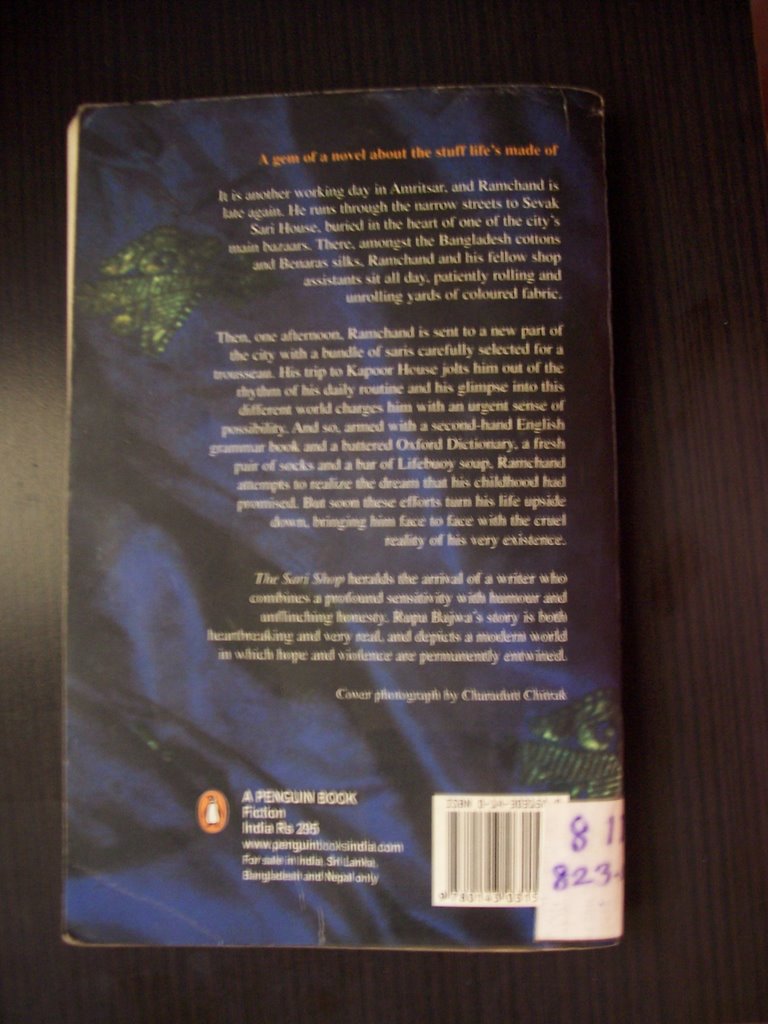
The Sari shop by Rupa Bajwa- Part two

Part two is shorter than part one, thankfully, as you have a lump in your throat almost throughout the second part of the book. The author wastes no time in plunging head forth into the much intriguing and heartbreaking story of Kamla, the wife of one of Ramchand’s co-workers. An account of the helpless woman, who is in a situation that, even we readers are not able to find a way out of, cannot be written better- tightly sketched and immensely spellbinding; something that the first-time novelist can take pride out of, and most likely, something that caught the attention of the Orange prize jury.

Even the distraction in the form of Shilpa’s aristocratic marital life [obviously inserted to strike a difference between the life of married women in the sari-buying and sari-selling class] is justifiable up to a certain extent. But what I could not come to terms with was the English professor Mrs. Sachdeva’s abrupt and largely inconsistent character sketch. The author drafts a respectable personality development of this particular character as the story unfolds, makes her sound intelligent during her rendezvous with Mrs. Bhandari and Rina Kapoor, and in the end, suddenly makes her scream at Ramchand quite unexplainably. If the idea was to show how volatile even the so-called social reformists are, it was not delivered across. Also, why Ramchand chose Mrs. Sachdeva over Rina Kapoor, who had warmed up to him so well, is confusing.

I am not sure if the author consciously made a subtle point where Ramchand buys books by both Indian and foreign authors, and instinctively chooses the former over the latter, as the unfamiliar names, places and situations make no sense to him; but it amused me no end. As the sari-buying class, we are almost made to feel guilty over Ramchand’s mayhem, and for his inability to “look-over” and “move-on” with social injustice, something we, as Indians, have so easily learnt to do over years. The story reaches the peak when he breaks down after reading an essay, from one of his books, about policemen, their importance to the society and the sacrifices they make to do their duties- truly moving.

It is with considerable regret that and Every coin has two sides, are Ramchand’s favourite lines of all the English he had managed to study in five months. When in his most traumatized moment he comes up with, It is with considerable regret that I say Kamla’s fate was sealed at that very moment, you know there is an author around the corner who seems to be very promising. As Ramchand clings on strongly to the two-sided coin, I will keep wondering about the unique styles adapted in the two parts of the book, especially the darker second part.
Rupa, your next book will not be a die-for but I will still have an eye open for it.

P.S: The author has a strong sensitivity to various kinds of smell; each scene is not complete for her without the mention of the odour attached to it. Eventually, the novel has left me sniffing and smelling pretty badly for the past two days!